
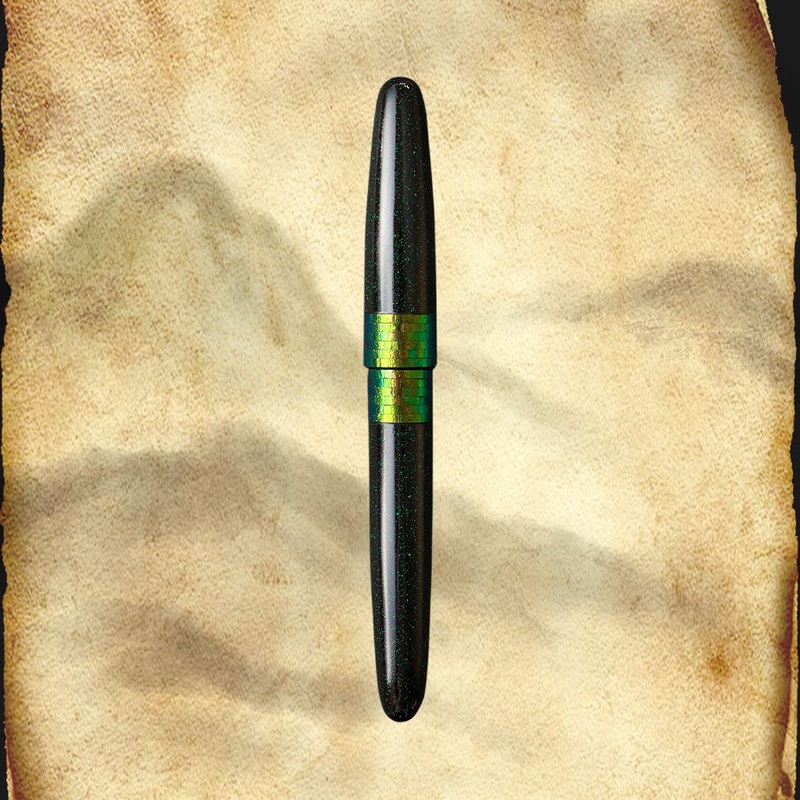
Dream Pen Tamamushi Wing Maki-e – Taishi no Yume
Important Note: Due to the delicate characteristic of natural material, please keep the pen from direct sun exposure for prolonged time Made from Jewel Beetle Tamamushi Wing Maki-e is our new fountain pen with a lustrous jet-black body and is decorated wit
Important Note: Due to the delicate characteristic of natural material, please keep the pen from direct sun exposure for prolonged time
Made from Jewel Beetle
Tamamushi Wing Maki-e is our new fountain pen with a lustrous jet-black body and is decorated with jewel beetle (Chrysochroa fulgidissima) or Yamato Tamamushi wing that reflects the shine like scattered shining jewelry. The wings have long been used in arts and crafts. Our design is inspired by a miniature altar in Nara made during the Asuka era called “Tamamushi Zushi.” Because of the use of its iridescent wing in the parts, the altar is named after the jewel beetle.
Now, WANCHER is bringing the Asuka era art technique to the present, Reiwa. Together with Wajima lacquer craftsmanship, the pen is thoroughly demonstrated in its transparent glow of Tamamushi wing, which resembles an aurora dancing in the sky depending on viewing angles. We are proud to present you the Dream Pen Tamamushi-Nuri Maki-e “Taishi no Yume.”
History
Tamamushi artwork was known to have been born during the Asuka period, the age when Japanese fine arts and architecture were blooming. The 8th ruler, Empress Suiko (554 – 628), and her nephew, Prince Shotoku, governed the political affairs. ‘Nihonshoki’ (The Chronicles of Japan) recorded that Prince Shotoku had a dream of seeing an aurora in the sky and regarded it as heaven. Thus the name “Taishi no Yume” (prince’s dream) was born.
The prince then determined to construct a pocket altar that would resemble the brilliant lights that he saw in the dream; “Tamamushi Zushi” was the result. The nowadays known national treasure “Tamamushi no Zushi” in Horyuji Temple in Nara is an adaptation of the one built during the Asuka period.
A Fountain Pen with a good luck symbol
The jewel beetle is also known as a lucky symbol. In the past, there was a belief that a woman who kept one in her closet drawers would be able to get more kimonos, and she would be able to find the partner she loved. At the time that the “Tamamushi Zushi” was built, only rich nobles could enjoy Tamamushi (jewel beetles) for their magnificence. This is evident in a haiku poem written by Yamagushi Seison during the Meiji and Showa era, “Green of jewel beetle wings is appreciated from Suiko empress’ era.”
The fusion of ancient Japanese lacquer craft & fountain pen
Tamamushi wing Maki-e technique is used in the national treasure “Tamamushi Zushi,” which is a collection of Horyuji Temple and the oldest Japanese lacquerware made about 1,400 years ago. Very few craftsmen inherited this technique; therefore, it was not easy to acquire its design know-how and knowledge. However, through WANCHER’s in-depth research, we overcame many difficulties and finally completed the design. Now, we would like you to take this new fountain pen, “Taishi no Yume,” in your hand and closely examine the multiple shining colors.
Techniques of Tamamushi Wing Maki-e
The outer wings of Tamamushi beetles, which are living jewels, are finely carved to fit on the curved surface of the fountain pen. Craftsmen carefully adhere pieces of the same brilliance, as if they were castle masonry. Maki-e is a technique in which a picture is drawn on a surface of lacquerware with urushi, and gold and silver powders are “sprinkled” (maku) before the lacquer dries, which then fixes the image in place. This meticulous technique requires the artisans to carefully carve the Tamamushi wings to fit on the curved surface of a fountain pen, and the craftsmen must carefully align the pieces to create a cohesive design.
The challenging part lies in fixing the wings of jewel beetles into a fountain pen because it contains a lot of oil that hinders the sticking process. Only highly skilled artisans can put together the jewel beetle’s wing and Opal pieces onto the black fountain pen, like an enchanted sight of the aurora and twinkling stars spread in the night sky.
Why We ChoseThe Technique
As we have mentioned before, ‘Tamamushi Zushi’ is the inspiration behind the Tamamushi wing Makie pen, and it was designated a national treasure in 1951. In the past, Empress Suiko (554 – 628), who ordered to make the Zushi, loved the beautiful glow of the Tamamushi design, and she kept it in her palace. Prince Shotoku, who governed the political affairs as a regent for Empress Suiko, also remarked on the Tamamushi design, “an appearance of aurora whose shape was like a tail of a peasant.”
WANCHER thought of bringing the brilliance of both aurora and jewel beetles, which made two nobles of the Asuka period, Empress Suiko and Prince Shotoku, which could be reflected in the design of the fountain pen.
Specifications
Material & art:Ebonite, Tamamushi, Maki-e, Urushi, Opal Stone
Filling mechanism:Converter or Cartridge (European International Standard)
Nib: #6 Jowo stainless steel, Wancher 18K gold
Feed: Plastic, ebonite black, ebonite red
Compact air-tight cap: Prevent dried-out ink problem

Size & Shape
 Packaging
 Packaging
Traditional Japanese Wooden Box + Pen Kimono + Instructional Materials + Certificate + Converter + Cartridge
Reviews
There are no reviews yet.